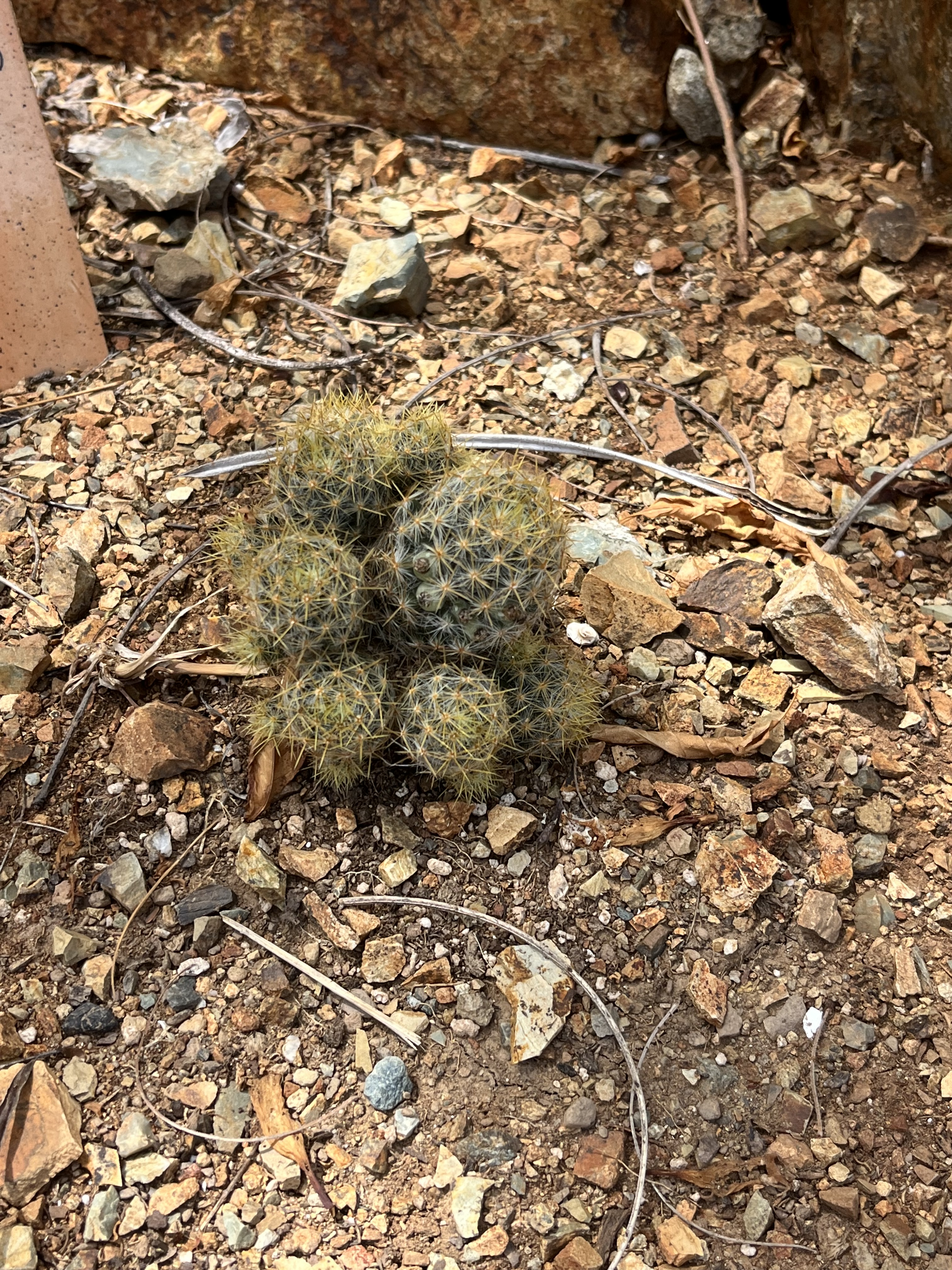
Origin and Habitat: The species occurs very widely from Mexico (Coahuila, Nuevo León, Querétaro, San Luis Potosí and Tamaulipas), the USA (Texas), Cuba, the Dominican Republic, and Haiti. The typical subspecies prolifera occurs throughout much of the Caribbean.
Altitude range: It is found at elevations of 400 to 2,250 metres above sea level.
Habitat and Ecology: The species grows in submontane scrub. In Texas, it occurs in grasslands at low elevations and in Cuba, the plant grows in low, dry thicket. Mammillaria prolifera is quite inconspicuous but has a very large extent of occurrence and is abundant. Although there are threats in places (habitat destruction through logging), they are not sufficient to warrant any concern.
Synonyms:
- Mammillaria prolifera (Mill.) Haw.
- Cactus mammillaris var. prolifer Aiton
- Cactus proliferus Mill.
- Cactus stellatus Willd.
- Chilita prolifera (Mill.) Orcutt
- Ebnerella prolifera (Mill.) Buxb.
- Escobariopsis prolifera (Mill.) Doweld
- Neomammillaria prolifera (Mill.) Britton & Rose
See all synonyms of Mammillaria prolifera
Common Names include:
ENGLISH: Nipple Cactus, Grape Cactus, Hair-covered Cactus, Pincushion Cactus, Silver-cluster Cactus, Little Candles, Texas Hair Cactus, West Indian Nipple-cactus, Texas Nipple Cactus
RUSSIAN (Русский): Маммилля́рия израста́ющая, Маммилля́рия побегоно́сная
SPANISH (Español): Biznaga Prolifera
Description: Mammillaria prolifera is a low growing cactus, commonly branching to form colonies often 6 dm in diameter. Four subspecies are recognized, the nominate subspecies, subspecies arachnoidea (D.R.Hunt) D.R.Hunt, subspecies haitiensis and subspecies multiceps (Salm-Dyck) U.Guzmán (including subsp. texana (Engelm.) D.R.Hunt.).
Stems: The individual stems dark green, globose, cylindric or club shaped to 9 cm high, 3 to 7 cm in diameter (6-7 cm in diameter in subsp. prolifera), of soft texture.
Tubercles: Cylindrical to conic, about 8 mm long, spreading, without latex, Axils of tubercles with several long, hair-like bristles.
Radial spines: 25-40, hair-like, often intergrading with the centrals, straight or twisted, white to yellow to brown, 3-12 mm long.
Central spines: 5 to 12, needle-like, puberulent, 4-9 mm long, much stouter than the radials, straight, white to yellow to reddish, with darker tips (Typcally yellow in subsp. prolifera).
Flowers: 10-18 mm long, borne in old axils but toward top of plant, small, yellowish white, cream or pinkish yellow. Inner perianth-segments erect, pale yellow, with brownish mid-rib, acute; filaments pale rose-coloured; anthers at first deflexed inward; style shorter than filaments; stigma-lobes 3, yellow.
Fruit: Crowned by persistent withering perianth, club shaped to cylindrical, somewhat curved, 1.5 to 2 cm long, scarlet.
Seeds: Black, pitted, a little depressed; aril white, triangular.More…
Subspecies, varieties, forms and cultivars of plants belonging to the Mammillaria prolifera group
- Mammillaria prolifera (Mill.) Haw.: (subsp. prolifera) has stems 6-7 cm in diameter, cream to pinkish yellow flowers and yellow spines. Distribution: throughout much of the Caribbean.
- Mammillaria prolifera subs. arachnoidea (D.R.Hunt) D.R.Hunt: has slender, fine central spines and quite narrow funnelform flowers. Distribution: Tamaulipas and Hidalgo.
- Mammillaria prolifera f. cristata hort.: Crested form


 BEARNOTCH