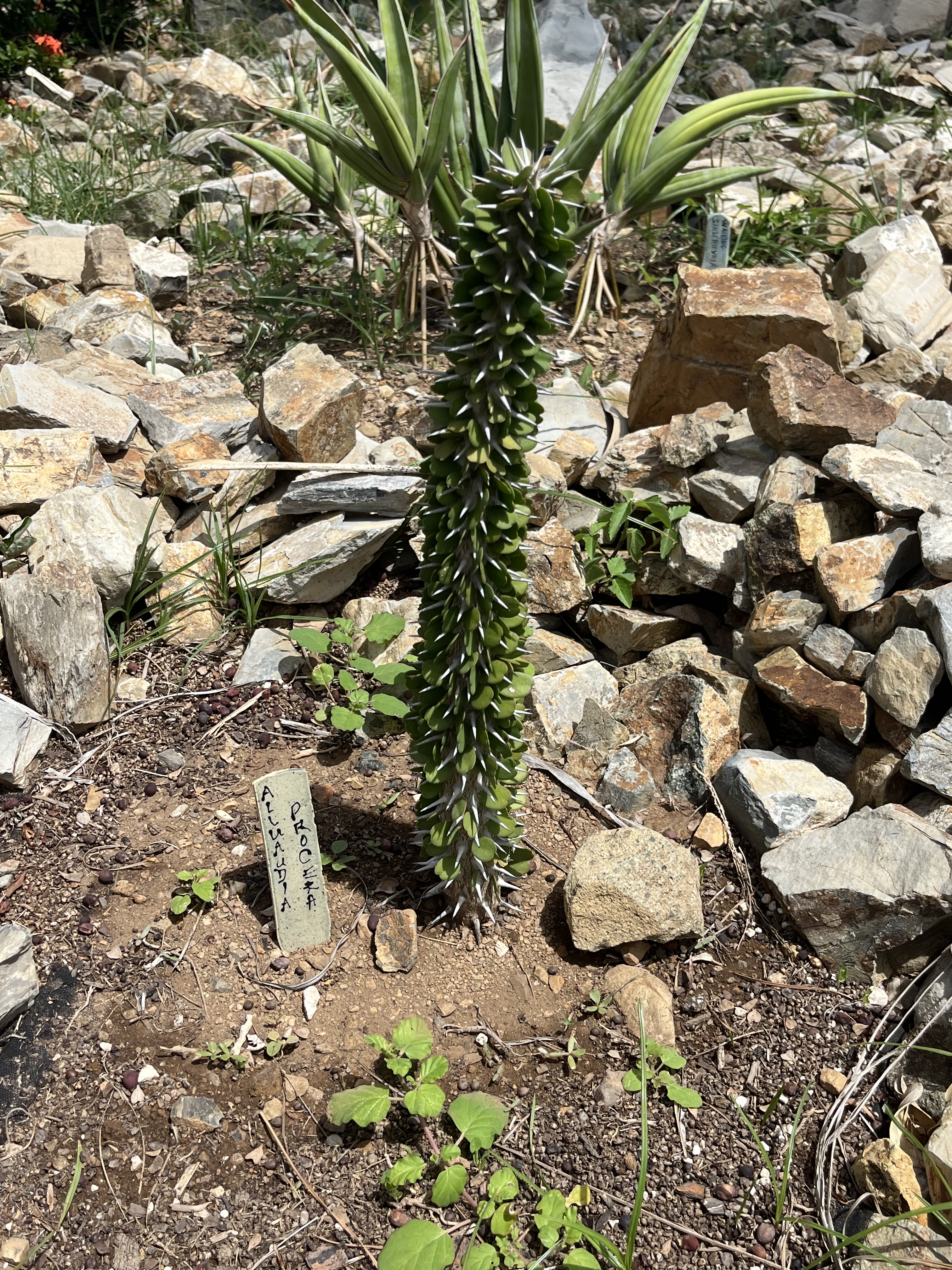
Origin and Habitat: Southern and southwestern Madagascar (Toliara).
Habitat & ecology: It is one of the thorny plants of the Madagascan spine forests (along with Pachypodium spp.) found in the island’s semi-arid southwest on crystalline bedrock more or less covered with sandy soil. It grows in areas that may receive no rain for more than a year. It can withstand extended periods of drought, yet lacks the water storage tissues associated with most true succulents. In it’s native habit Alluadia varies from small shrublike to tall tree like plants. Some branch profusely and others are more solitary. All are deciduous in the dry season but leaf out virtually over night when the rains come.
Synonyms:
- Alluaudia procera Drake
- Didierea procera Drake
Common Names include:
ENGLISH: Octopus tree, Madagascar Ocotillo, Madagascan Ocotillo, African Ocotillo
MALAGASY: Fantsilohitra, Fantsiholitra
Description: Alluaudia procera is a spiny and scarcely branched or occasionally columnar, small succulent tree with a very upright habit that looks a lot like a ‘crown of thorns’. The plant can grow rather tall, 1,5-3 m high indoors and up to 18 m tall in its native haunts (but cultivated plant rarely surpass the 8 m of height). In its early years this plant grows like a bush. Later its mature tree shape appears, this is the only truly woody Didiereacea. It can be identified at a distance by the spherical terminal inflorescences balancing on the top of each branch.
Stem: Succulent almost unbranched, thin and corrugated tube-like, mostly columnar covered with regularly spaced sharp, conical, tapering thorns and leaves arranged in parallel tracts spiraling up the trunk. The stem is of a beautiful bone white colour and lignifies as the plant ages and will reach a diameter of 15 cm at the base. The branches raised to the sky, quasi parallel, are slightly curved at apex, recalling a half-opened fan or the arms of a squid.
Leaves: Small, oval or rounded, green succulent that bud right off the trunk, 1 to 5 cm (or more) long.
The leaves clothe the stems during the warm wet season, but will often drop during any lengthy dry periods or (usually in cultivation) with the onset of winter.
Flowers: Yellowish white in crowded clusters at the end of the branches. Flowers will be produced in mature specimens taller than 3 m on separate male and female plants.More…
Notes: Alluaudia procera, or Madagascar Ocotillo in many ways it resembles the American Ocotillo (Fouquieria splendens) with red flowers. Both have small rounded leaves and grayish trunks with a lot of spines, but that is where the similarities and in fact they belongs to two different families. This is a perfect example of convergent evolution – unrelated plants adapting similar shapes and survival strategies in response to the same environmental conditions.


 BEARNOTCH