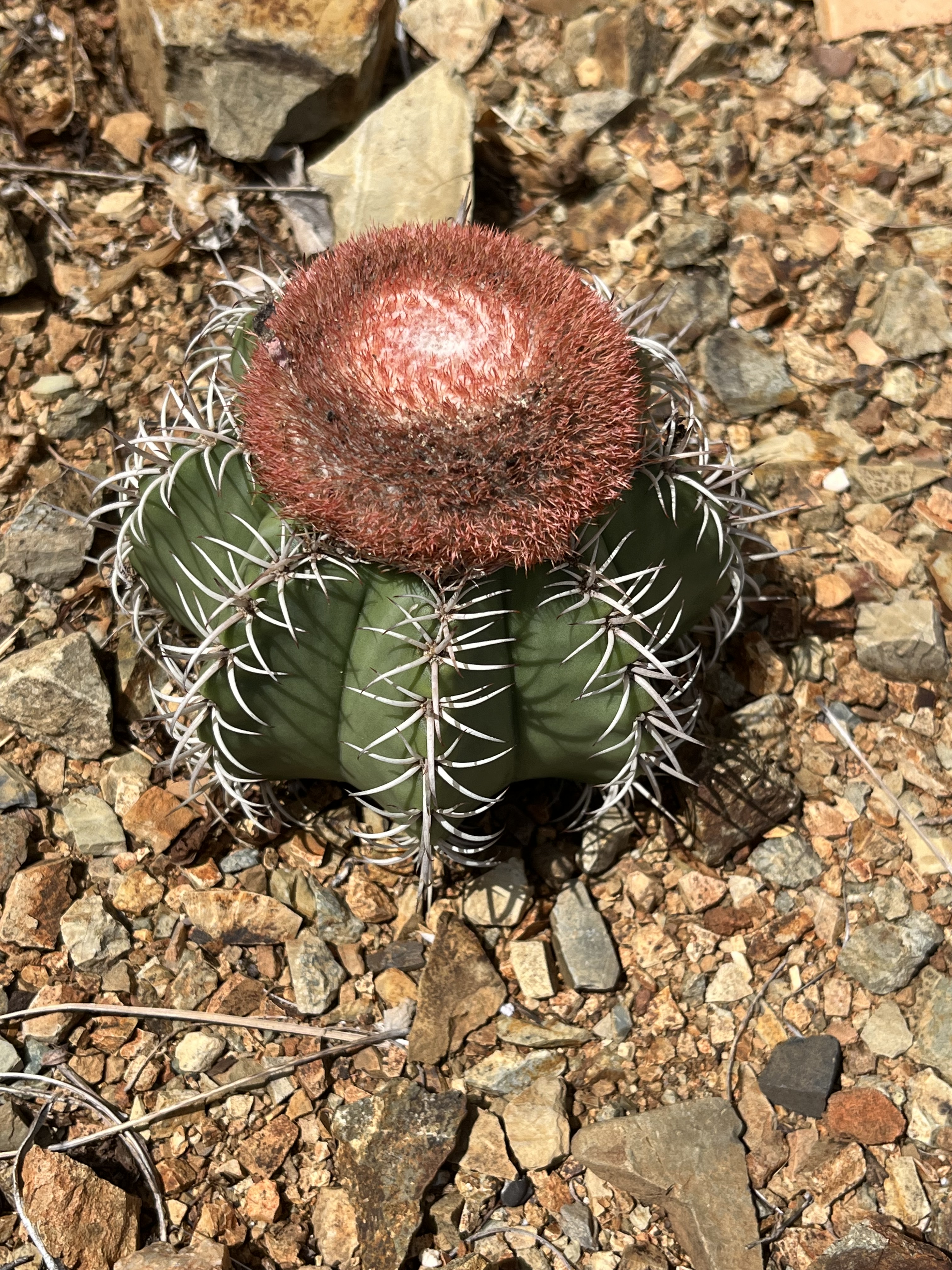
Melocactus Curvispinus Turk’s Cap Cactus (from plantdesert.com).
The common name of the Globose-shaped Melocactus curvispinus is “Turk’s Cap Cactus.” It has its origin in Mexico and is widely known for its reddish cap-like structure. Hence, the winter-dormant cacti get their name as the Turk’s Cap. Melocactus curvispinus belongs to the Cactaceae family and usually grows up to a height of 1 foot.
Growth Rate
Melocactus curvispinus has a slow growth rate and needs regular care to develop further.
Flowering
The blooming season begins in spring and lasts till summer. Pale Pink Magenta flowers originate in the cap-like region. The flowers later develop into pepper-shaped pink-colored non-edible fruits.
Watering and Feeding
Turk’s cap cactus needs regular watering even during the dormant winter season. It requires feeding once in four weeks, especially with phosphorus and potassium-rich fertilizer during summers.
Soil
Melocactus curvispinus needs moist soil with good drainage. The soil should never get completely dry.
Hardiness
This houseplant belongs to the hardiness zone of 11. The plant has a frost tolerance of 8-12° C (46.4-53.6° F).
Light
This interesting plant grows well in full sun exposure and even in partial shade. The plant needs plenty of bright light to flower.
Propagation
This variety of cacti can be successfully propagated from seeds during the spring season.
Melocactus curvispinus or ‘Turk’s cap cactus’ is excellent for patios and garden rock settings. It makes for a suitable gifting item too.
Some of the information in this description has been found at desert-tropicals.com, llifle.com and cactus-art.biz
| Blooming Season | Spring to summer |
|---|---|
| Common Name | Turk’s cap cactus |
| Dormancy | Winter |
| Family | Cactaceae |
| Flower | Pale pink magenta (pink-purple) |
| Frost Tolerance | 8-12°C |
| Growth Rate | Slow-growing |
| Hardiness Zone | 11 |
| Height | 1 foot |
| Origin | Mexico |
| Pot Size | 3.5″ |
| Scientific Name | Melocactus curvispinus |
| Shape | Globose |
| Sun Exposure | Full sun to partial shade |
Cultivation and Propagation: These cacti are not the easiest things to grow and aren’t plants for beginners. Melocactus guaricensis grows from April to October, it can’t endure long stretches of total dryness, and also too much water will rot it, as its weak root systems tends to be inefficient at sucking up water from wet soil. Nonetheless, again as a result of their tropical origins, they need a fair amount of water, but allow the soil to dry quite a bit before watering again.
Melocactus rests from October to April but can’t stand cold, or even fairly cool temperatures, so is indispensable to keep it above 8-12°C at all times, severe damage or death occurring at temperatures that the great majority of cacti wouldn’t mind in the least and prefer more frequent water in winter than other cacti, say once a month. Do not feed in winter.
The root system is weak and generally resents being repotted and can take a long time to re-establish. The soil mix should be very quick draining, prefers very bright light, not as much as the most arid growing cacti, but plenty nonetheless.
Propagation: Exclusively by Seeds. Sow in February-march in a light, sandy, porous soil. Cover germinating tray with glass to prevent seed from drying out. Germination is most successful at a temperature of 18 to 22° C.


 BEARNOTCH